Agentic AI: The Big Picture — Designing the Agentic Layer for True Autonomy
Agentic AI: The Big Picture — Designing the Agentic Layer for True Autonomy
Artificial Intelligence has evolved in waves — from predictive analytics to deep neural networks to Generative AI. But the next major leap isn’t just about generating better text, code, or images. It’s about agency.
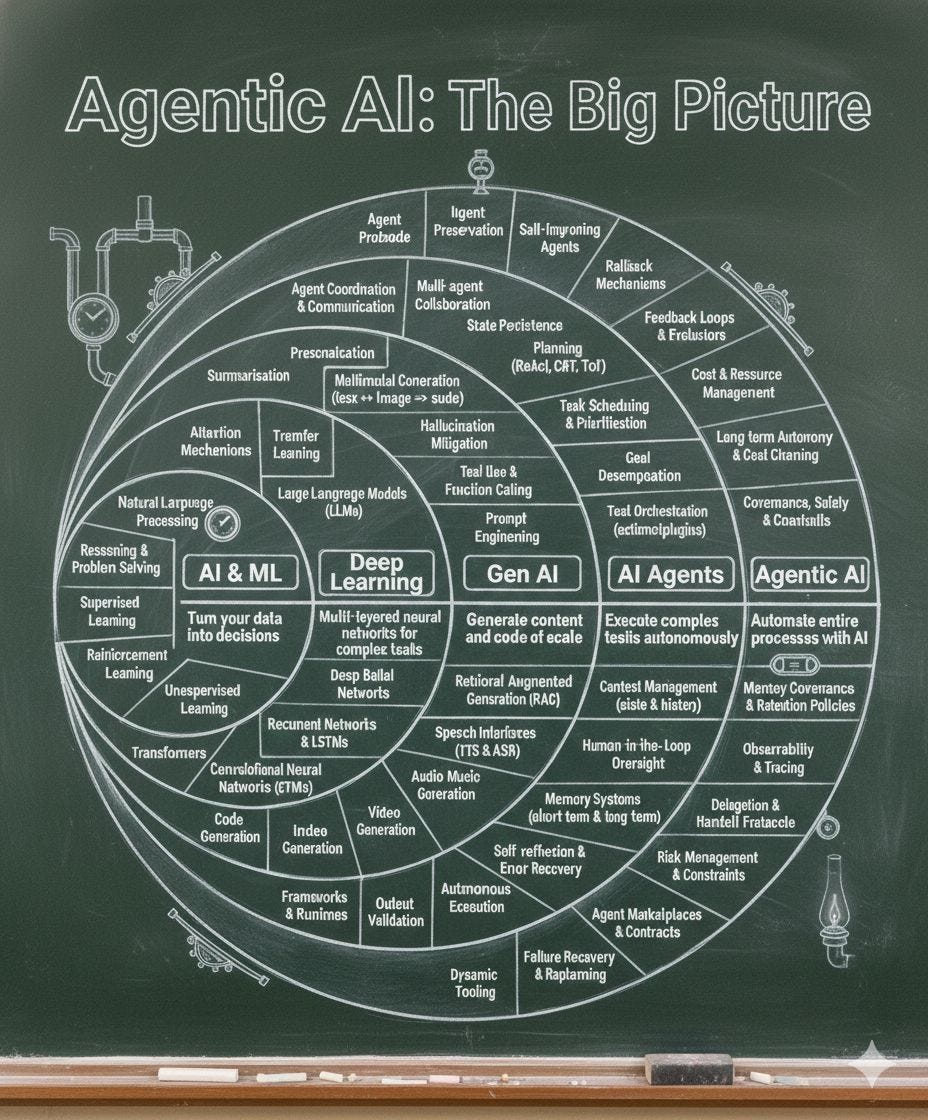
The real transformation is happening in what we call the Agentic Layer — the architectural layer that enables AI systems to plan, execute, collaborate, recover, govern, and optimize end-to-end workflows.
If GenAI gave us powerful brains, the Agentic Layer gives those brains executive function.
The Evolution Toward Agentic AI
To understand the Agentic Layer, we must see how AI matured across layers of capability.
1️⃣ AI & ML — Turning Data into Decisions
The foundational layer includes:
- Supervised Learning
- Unsupervised Learning
- Reinforcement Learning
- Reasoning & Problem Solving
- Natural Language Processing
- Attention Mechanisms
- Transfer Learning
- Transformers
At this stage, AI systems analyze patterns and produce predictions.
They help humans decide. But they don’t act independently.
2️⃣ Deep Learning — Multi-Layered Intelligence at Scale
Deep learning introduced the ability to process complex, high-dimensional data through:
- Convolutional Neural Networks (CNNs)
- Recurrent Networks & LSTMs
- Deep Belief Networks
- Large Language Models (LLMs)
This layer unlocked massive scalability and contextual understanding. Still, these systems remained reactive — they respond when prompted.
3️⃣ Generative AI — Creation at Scale
Generative AI extended capabilities into production-grade generation:
- Code Generation
- Image Generation
- Video Generation
- Audio & Music Generation
- Speech Interfaces (TTS & ASR)
- Retrieval-Augmented Generation (RAG)
- Prompt Engineering
- Tool Use & Function Calling
- Hallucination Mitigation
- Output Validation
- Frameworks & Runtimes
- Autonomous Execution
- Self-reflection & Error Recovery
- Dynamic Tooling
GenAI can generate, synthesize, and even call tools. But it still doesn’t own a workflow end-to-end. It produces outputs — it doesn’t manage objectives.
The Agentic Layer: Where Autonomy Emerges
The Agentic Layer builds on GenAI and transforms it into an autonomous system capable of structured execution.
Instead of:
“Generate a report.”
An agentic system can:
Understand the goal → Break it down → Schedule tasks → Call tools → Validate outputs → Recover from failure → Deliver → Monitor → Optimize.
That shift changes everything.
Core Capabilities of the Agentic Layer
Below are the essential capabilities that define Agentic AI.
🧠 1. Planning & Reasoning
- Planning (ReAct, CoT, ToT)
- Goal Decomposition
- Task Scheduling & Prioritization
- Long-term Autonomy & Goal Chaining
Agentic systems translate high-level intent into executable sub-tasks. They don’t just answer questions — they structure execution strategies. This is where reasoning becomes operational.
🔄 2. State & Memory Management
- State Persistence
- Context Management (state & history)
- Memory Systems (short-term & long-term)
True autonomy requires continuity. Agents maintain task state, historical actions, intermediate results, and user context. Without memory, every interaction resets. With memory, workflows evolve.
🤝 3. Multi-Agent Collaboration
- Agent Coordination & Communication
- Multi-agent Collaboration
- Agent Protocols
- Delegation & Handoff Protocol
Complex workflows often require specialized roles:
- Planner agent
- Research agent
- Executor agent
- Validator agent
These agents communicate through structured protocols — similar to organizational hierarchies. The Agentic Layer enables this coordination.
🛠 4. Tool Orchestration & Execution
- Tool Orchestration (actions/plugins)
- Dynamic Tooling
- Agent Marketplaces & Contracts
Agentic systems interact with:
- APIs
- Databases
- Software platforms
- Internal enterprise systems
They dynamically choose tools, execute actions, and integrate results into ongoing workflows. This transforms LLMs into decision-and-action engines.
🔍 5. Feedback, Evaluation & Rollbacks
- Feedback Loops & Evaluators
- Rollback Mechanisms
- Failure Recovery & Replanning
- Self-improving Agents
Autonomy demands resilience.
Agentic systems:
- Evaluate outputs
- Detect errors
- Roll back faulty steps
- Replan
- Retry
This significantly reduces hallucinations and operational risk.
⚖ 6. Governance, Risk & Resource Management
Autonomy without governance is dangerous. The Agentic Layer includes:
- Governance, Safety & Guardrails
- Risk Management & Constraints
- Cost & Resource Management
- Observability & Tracing
- Memory Governance & Retention Policies
- Human-in-the-Loop Oversight
These ensure:
- Compliance
- Auditability
- Budget control
- Ethical boundaries
- Enterprise trust
This is what makes Agentic AI production-ready.
🎯 7. Intent Preservation
As tasks get decomposed and delegated, the original objective must remain intact.
- Intent Preservation
- Goal Integrity Tracking
Agentic systems continuously align sub-actions with the original goal — preventing drift across long execution chains.
The Architecture of an Agentic System
A mature Agentic Layer typically includes:
- Large Language Model (LLM)
- Planning Engine
- Tool Registry
- Memory Store (short + long term)
- State Manager
- Task Scheduler
- Evaluator / Critic Module
- Execution Engine
- Observability Layer
- Governance & Policy Engine
- Rollback & Recovery Mechanisms
Think of it as:
GenAI = Brain
Agentic Layer = Nervous System + Executive Control
It resembles an operating system for AI-driven workflows.
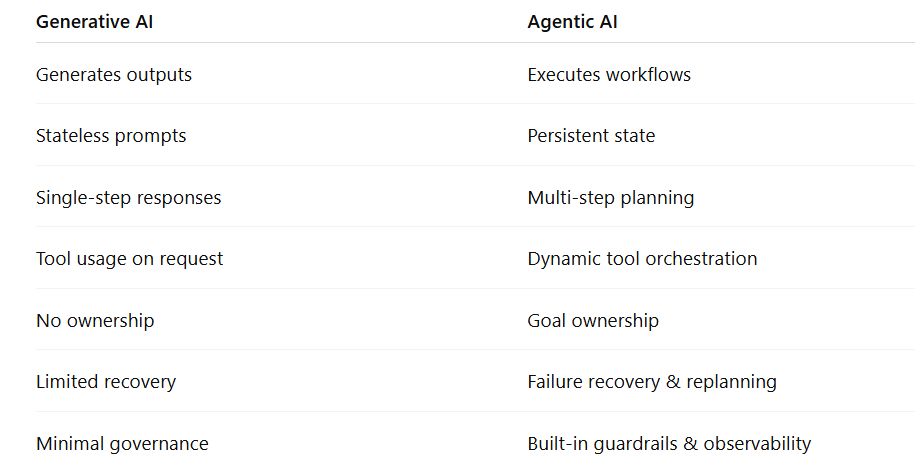
What Makes Agentic AI Different?
Real-World Applications Examples
🔹 Enterprise Workflow Automation
End-to-end procurement, onboarding, compliance, reporting.
🔹 IT & DevOps Agents
Detect → Diagnose → Remediate → Monitor → Optimize.
🔹 Financial Operations
Reconcile → Validate → Audit → Escalate → Archive.
🔹 Autonomous Research
Collect → Summarize → Cross-check → Forecast → Recommend.
🔹 Multi-Agent Business Systems
Specialized AI agents collaborating across departments.
The Strategic Shift: For technology leaders, architects, and program managers: The competitive advantage won’t be:
- Who has access to the largest LLM.
It will be:
- Who designs the most robust Agentic Layer.
This is a systems engineering challenge.
An orchestration challenge.
A governance challenge.
A cost-optimization challenge.
It’s no longer about better prompts. It’s about better architecture.
Final Thoughts
Agentic AI represents the transition from:
- Intelligence-as-a-service to Autonomy-as-a-system
The Agentic Layer is not a feature. It is an operating model for the future of enterprise automation.
Thanks for your time, if you enjoyed this short article there are tons of topics in advanced analytics, data science, and machine learning available in my medium repo. https://medium.com/@bobrupakroy
Some of my alternative internet presences are Facebook, Instagram, Udemy, Blogger, Issuu, Slideshare, Scribd, and more.
Also available on Quora @ https://www.quora.com/profile/Rupak-Bob-Roy
Let me know if you need anything. Talk Soon.
Check out the links, i hope it helps.


Comments
Post a Comment